11th Class Biology Pairing Scheme 2026: Definitive Assessment Guide for Gujranwala
Table of Contents
Securing a top position or achieving a perfect score in Intermediate Part-I Biology requires a dual approach: a deep conceptual understanding of biological sciences alongside a highly optimized study strategy. The examination paper layout for Higher Secondary School Certificate (HSSC Part 1) is rigorously structured, meaning students who understand how questions are distributed can prioritize their revisions much more effectively.
The comprehensive guide provides an in-depth breakdown of the 11th Class Biology Pairing Scheme 2026. This structure is standard across all educational boards in Punjab, with a specific focus on the requirements of the Gujranwala Board (BISE Gujranwala). By mastering how chapters are grouped, you can design a study plan that ensures maximum marks with zero wasted effort.
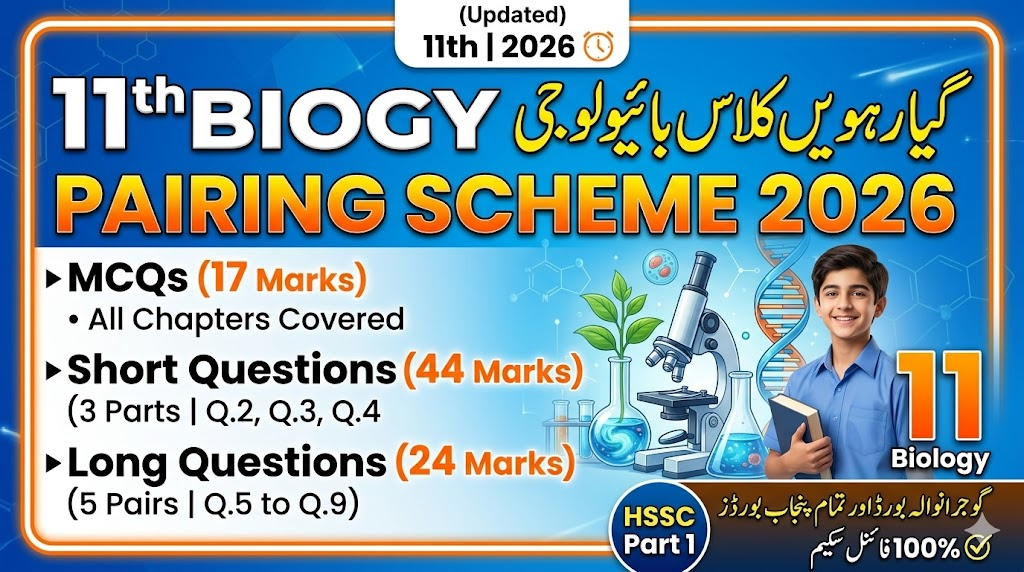
The 11th Class Biology examination consists of a total theory paper of 85 marks (with the remaining 15 marks evaluated through practical examinations). To plan your time and prep effectively, it is critical to look at the three primary sections of the written exam:
Objective Section (MCQs): 17 Marks (17 questions, 1 mark each)
Subjective Section Part I (Short Questions): 44 Marks (22 questions to be answered, 2 marks each)
Subjective Section Part II (Long Questions): 24 Marks (3 descriptive questions to be answered, 8 marks each)
The objective paper contains 17 mandatory multiple-choice questions. According to the blueprint, almost every single chapter of the 14-chapter textbook contributes to this section, making a thorough reading of the text lines vital.
Chapter Number
Subject Matter Area
Allocated MCQs
Chapter 1
Introduction to Biology
1 MCQ
Chapter 2
Biological Molecules
1 MCQ
Chapter 3
Enzymes
1 MCQ
Chapter 4
The Cell
1 MCQ
Chapter 5
Variety of Life
1 MCQ
Chapter 6
Kingdom Monera (Prokaryotes)
1 MCQ
Chapter 7
Kingdom Protista (or Protoctista)
1 MCQ
Chapter 8
Kingdom Fungi
1 MCQ
Chapter 9
Kingdom Plantae
1 MCQ
Chapter 10
Kingdom Animalia
2 MCQs
Chapter 11
Bioenergetics
2 MCQs
Chapter 12
Nutrition
1 MCQ
Chapter 13
Gaseous Exchange
1 MCQ
Chapter 14
Transport
2 MCQs
Total Weight
Whole Syllabus Evaluation
17 Marks
Strategy Tip for Objective Success: Chapters 10, 11, and 14 are your high-yield zones here, accounting for over 35% of the total MCQ marks. Focus extra attention on the bolded terms, biological cycles, and taxonomic classifications within these three chapters.
3. Subjective Section Part I: Short Questions (44 Marks)
The short-answer portion is the heaviest part of the written exam, making up 51.7% of the total theory marks. It is split into three main question blocks (Questions #2, #3, and #4). Each block contains built-in selection choices, offering an excellent opportunity for selective study.
Question #2: (Attempt any 8 out of 12 Questions — 16 Marks)
This section heavily evaluates structural biology, bioenergetics, and animal diversity:
Chapter 2: 1 Question
Chapter 3: 3 Questions
Chapter 8: 2 Questions
Chapter 10: 4 Questions
Chapter 11: 2 Questions
Question #3: (Attempt any 8 out of 12 Questions — 16 Marks)
This block tests cellular mechanics, plant evolution, basic micro-organisms, and complex transport systems:
Chapter 1: 2 Questions
Chapter 4: 2 Questions
Chapter 7: 4 Questions
Chapter 9: 2 Questions
Chapter 14: 2 Questions
Question #4: (Attempt any 6 out of 9 Questions — 12 Marks)
This final short question pool focuses on diversity of simpler organisms, cellular nutrition, and respiratory systems:
Chapter 5: 1 Question
Chapter 6: 1 Question
Chapter 12: 3 Questions
Chapter 13: 4 Questions
4. Subjective Section Part II: Extensive Long Questions (24 Marks)
The descriptive long questions section offers 5 extensive pairs, and students must select and complete 3 total questions. Each question is divided into a part (a) and a part (b), worth 4 marks each.
As clearly shown, the 2026 exam strictly incorporates Student Learning Outcomes (SLO) criteria categorized into K (Knowledge), U (Understanding), and A (Application).
Question Ref.
Part (a) Source Chapter
Part (b) Source Chapter
Structural Type / Restrictions
Question #5
Chapter 1
Chapter 14
Evaluated on Knowledge & Understanding (K/U)
Question #6
Chapter 2
Chapter 8
Evaluated on Knowledge & Understanding (K/U)
Question #7
Chapter 6
Chapter 9
Special Restriction: Chapter 9 excludes flower families
Question #8
Chapter 5
Chapter 11
Part (a) is Knowledge-based (K); Part (b) is Application-based (A)
Question #9
Chapter 4
Chapter 12
Part (b) is Application-based (A)
5. Expert E-E-A-T Academic Strategy for Gujranwala Board
To minimize study fatigue and secure top scores, students can use these vetted preparation paths:
The Smart Pairing Route (Questions #5, #6, and #7): By preparing Chapters 1, 2, 6, 8, 9, and 14 for long questions, you can bypass the complex application-based (A) assessment vectors of Bioenergetics (Chapter 11) and Nutrition (Chapter 12). Furthermore, Chapter 9 explicitly excludes detailed flower families for this pair, significantly reducing memorization load.
Mastering the “Application” Questions: If you choose to answer Question #8 or #9, remember that application questions will not simply ask you to list facts. Be ready to explain scenarios—such as how a specific enzyme inhibitor impacts a process, or how changes in light wavelengths alter the dark reactions in bioenergetics.
Diagram Integration Policy: In Punjab Board marking, biology long answers look far more credible and earn higher marks when accompanied by neat, labeled diagrams (e.g., fluid mosaic model for Chapter 4, or bacteriophage life cycles for Chapter 5), even if the prompt doesn’t explicitly ask for one. Always draw clear diagrams to give your answers an edge.