For intermediate students under the Board of Intermediate and Secondary Education (BISE) Gujranwala, scoring maximum marks in compulsory subjects like Islamiat Lazmi (11th Class) is the secret to raising your overall percentage. Because Islamiat is a high-yield, concise subject, a strategic study approach can easily secure a perfect or near-perfect score.
While BISE Gujranwala increasingly integrates SLO-based (Student Learning Outcomes) conceptual questions into the intermediate exams, the core weightage distribution remains highly consistent with the established board criteria. Below is the comprehensive, chapter-wise breakdown and preparation strategy designed to achieve an A+ grade in your 2026 board exams.
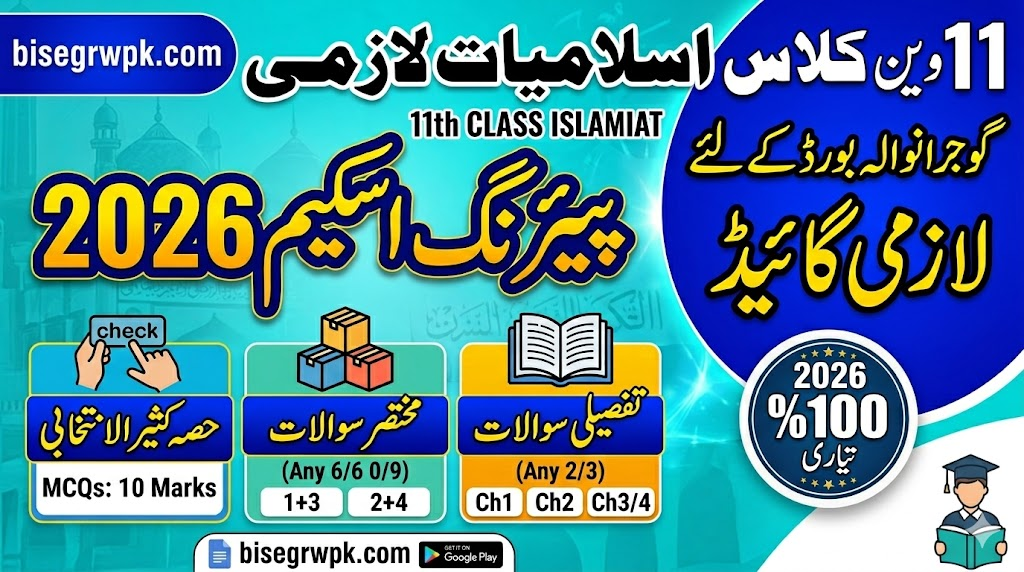
The 11th Class Islamiat Compulsory exam carries a total weightage of 50 marks. Understanding how these marks are divided among different assessment modules is the first step toward smart exam preparation.
1. Multiple Choice Questions (Objective Portion) — 10 Marks
The objective section consists of 10 compulsory MCQs, which are directly extracted from both the exercise texts and the core reading content of the chapters. According to image_a4a539.png, the chapter-wise allocation is as follows:
Chapter Number & Topic Area
Number of MCQs
Total Marks
Chapter 1
2 MCQs
2 Marks
Chapter 2
2 MCQs
2 Marks
Chapter 3
2 MCQs
2 Marks
Chapter 4
4 MCQs
4 Marks
💡 Core Insight: Chapter 4 carries double the objective weightage compared to any other individual chapter. Ensure you meticulously highlight dates, specific names, key Arabic terminologies, and factual historical data within this chapter during your regular reading phases.
2. Short Questions (Subjective Portion) — 24 Marks
The short questions section determines nearly half of your total grade. It is divided into two distinct sub-questions (Question #2 and Question #3). In each section, you are given 9 questions, and you must attempt any 6. Each correct short answer yields 2 marks.
Question #2 Structure
This section pulls a total of 9 questions exclusively from Chapter 1 and Chapter 3:
Chapter 1: 5 short questions
Chapter 3: 4 short questions
Selection Rule: Attempt any 6 out of these 9 choices.
Question #3 Structure
This section targets Chapter 2 and Chapter 4:
Chapter 2: 5 short questions
Chapter 4: 4 short questions
Selection Rule: Attempt any 6 out of these 9 choices.
3. Long Questions (Subjective Portion) — 16 Marks
The final section evaluates your descriptive capabilities and thematic depth. You are presented with 3 extensive subjective questions, and you must attempt any 2. Each long question carries 8 marks, often broken down into sub-components or requiring extensive references (Ahadith and Quranic verses).
The conceptual pairing for the descriptive section is mapped directly to individual chapters:
Question #5: Extracted entirely from Chapter 1
Question #6: Extracted entirely from Chapter 2
Question #7: Extracted combining concepts from Chapter 3 and Chapter 4
High-Yield Strategy: How to Leverage the Scheme for an A+
The SLO-Based Mindset Shift
As highlighted in the board’s technical updates (referenced in the footnotes of image_a4a539.png), modern papers rely significantly on conceptual understanding. Rote memorization of past papers alone will not suffice. Examiners are targeting the application and core understanding of Islamic concepts in contemporary contexts.
1. The “Power Chapter” Pairing Route
If your goal is absolute efficiency, notice the structural alignment:
Chapters 1 and 2 collectively provide 10 Short Questions (giving you more than enough cushion to complete the required 6 answers in both Question #2 and Question #3 slots).
Chapters 1 and 2 host Question #5 and Question #6 in the long question panel. By mastering the core theoretical systems, detailed definitions, and textual arguments of just these two chapters, you can theoretically cover your entire long question requirement perfectly.
2. The Verification of Arabic References
An 8-mark descriptive question in Islamic Studies requires authentic textual validation to receive full marks. When preparing long questions from Chapter 1 (e.g., Tauheed, Risalat, Akhirat) or Chapter 2 (e.g., Arkan-e-Islam), practice writing the corresponding Arabic text or precise translation of relevant Quranic Ayat and Ahadith. Leaving out scriptural references often results in a penalty of 2 to 3 marks per question.
Actionable 7-Day Exam Revision Routine
To convert this blueprint into realistic exam success, apply this targeted weekly structure when exam season arrives:
Days 1–2 (Focus on Chapter 1): Master the fundamental beliefs. Write out short notes on arguments for the Hereafter (Akhirat). Memorize at least 3 distinct verses proving the Finality of Prophethood (Khatam-an-Nabiyyin).
Days 3–4 (Focus on Chapter 2): Detail the operational pillars of Islam (Namaz, Roza, Zakat, Hajj). Focus on their societal and individual impacts, as SLO questions frequently ask: “How does Zakat reduce socioeconomic inequality?”
Day 5 (Focus on Chapter 3 & 4): Review Uswa-e-Hasna and the foundational traits of Islamic culture. Read Chapter 4 thoroughly to secure your 4 objective marks.
Day 6 (Past Paper Evaluation): Set a timer for 2 hours and attempt a recent Gujranwala Board past paper using only the permitted choices from the pairing framework.
Day 7 (Presentation & Handwriting Polish): Practice utilizing cut markers (604/605) for clear verse headers. Ensure your handwriting speed allows you to complete the 12 short answers and 2 long essays within the official time limit.
The 11th Class Islamiat Lazmi Pairing Scheme 2026 is a valuable roadmap for optimized study. By acknowledging that the paper structure relies closely on these specific chapter weightages, you can avoid over-studying passive material and direct your attention where the marks are concentrated. Focus on conceptual clarity, perfect your references, and approach your BISE Gujranwala exam with total confidence.