The Board of Intermediate and Secondary Education (BISE) Gujranwala has officially released the re-admission and registration schedule for the 9th class for the academic session 2026–2028. This vital notification outlines the complete timeline, guidelines, and fee structures for students seeking re-admission and registration updates following previous academic results or examination updates.
Important Dates and Schedule Timeline
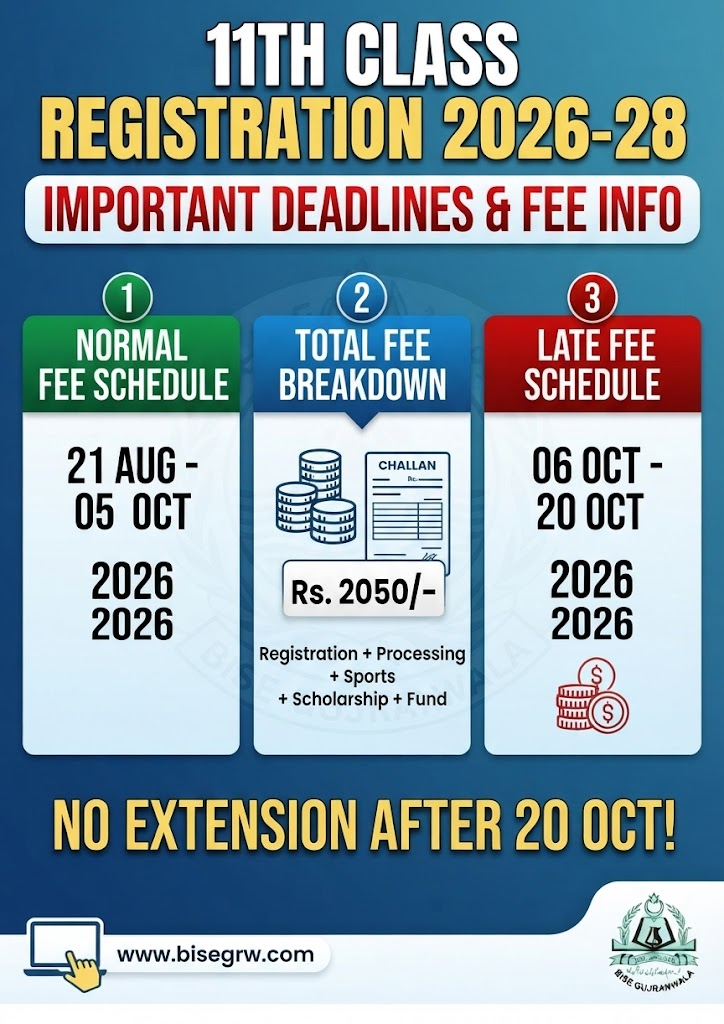
According to the official circular issued under registration memo guidelines, the processing window for data entry and online fee submission for re-admission spans from September 2, 2026, to October 1, 2026. Educational institutions under the board’s jurisdiction must ensure all data entries and challan verifications are completed within this designated timeframe, as no further offline or unapproved extensions will be entertained past the final cutoff date of October 1, 2026.
Fee Structure and Financial Breakdown
The board has categorized the fee parameters clearly for re-admission candidates versus fresh admissions to maintain transparent processing:
| Admission Type & Fee Component | Amount (PKR) |
| Re-admission Registration Fee Breakdown | Total: Rs. 2,050 |
| Registration Fee | Rs. 1,050 |
| Processing Fee | Rs. 200 |
| Sports Fee | Rs. 150 |
| Scholarship Fee | Rs. 200 |
| Development Fund | Rs. 500 |
| Fresh Admission Registration Fee Breakdown | Total: Rs. 8,000 |
| Registration Fee | Rs. 5,350 |
| Processing Fee | Rs. 600 |
| Sports Fee | Rs. 200 |
| Scholarship Fee | Rs. 150 |
| Development Fund | Rs. 200 |
| Late Registration Fee | Rs. 500 |
| Special / Additional Fee | Rs. 1,000 |
| Fresh Admission Registration Fee Breakdown | Total: Rs. 8,000 |
| Registration Fee | Rs. 5,350 |
| Processing Fee | Rs. 600 |
| Sports Fee | Rs. 200 |
| Scholarship Fee | Rs. 150 |
| Development Fund | Rs. 200 |
| Late Registration Fee | Rs. 500 |
| Special / Additional Fee | Rs. 1,000 |
Key Guidelines and Policies for Schools and Students
- Cancellation of Previous Records: For students re-admitted into the 9th class for the 2026–28 session who were previously registered, their older registration numbers stand officially cancelled upon processing the new re-admission. Institutions are required to deposit a cancellation penalty/fee of Rs. 1,000 per student through the designated web portal.
- Mandatory Portal Utilization: All school headmasters and administrators must conduct online data entries exclusively through the official BISE Gujranwala portal. Manual applications or handwritten requests for registration modifications will not be accepted under any circumstances.
- Support and Inquiries: For technical difficulties regarding online data insertion, password retrievals, or specific candidate case verifications regarding the 2026 examination results, school authorities can contact the Assistant Controller of Examinations (Matric) directly or reach out via the board’s dedicated helpline extensions.
Staying updated with these procedural requirements ensures that students avoid late surcharges and secure their official enrollment status for the 2026–2028 matriculation cycle smoothly.
Frequently Asked Questions (FAQs)
What is the official schedule for 9th class re-admission and registration for the 2026–2028 session?
- Online data entry and fee submission for re-admission run from September 2, 2026, to October 1, 2026.
Can students submit applications after the October 1, 2026 deadline?
- No, after October 1, 2026, admissions and registrations will not be permitted under any circumstances.
What is the total fee for 9th class re-admission?
- The total re-admission registration fee is Rs. 2,050 per candidate, which includes registration, processing, sports, scholarship, and development fund components.
What is the total fee for fresh admissions?
- The total fresh admission registration fee is Rs. 8,000 per candidate.
What happens to a student’s previous registration if they are re-admitted?
- For students re-admitted into the 9th class for the 2026–28 session, any previously issued registration numbers are officially cancelled, requiring a cancellation fee of Rs. 1,000 payable via the web portal.
Practical Examination Reforms: A Critical Assessment
The practical examination reforms introduced by educational boards, particularly within the Gujranwala board, have sparked considerable debate. While traditionalists welcome the revival of foundational inquiry, the historical reality remains that major innovations—ranging from Dalton’s theories and the invention of the light bulb to machinery, airplanes, modern computers, and advanced online systems—are the direct fruits of practical work. Landmark achievements by Pakistani scientists, such as Dr. Abdus Salam winning the Nobel Prize, and nuclear pioneers like Dr. Abdul Qadeer Khan and Dr. Samar Mubarakmand, trace back to robust scientific training grounds.
However, recurring flaws in execution often stem from designing systems without fully consulting the grassroots educators who actually manage the ground realities. A glaring example seen recently involves an examiner bogged down by excessive administrative tasks: managing data entry for 30 students, recording attendance, and signing documents across five different places. Trapped in this paperwork burden, the examiner and students are left entirely unable to properly observe or perform practical experiments, rendering the process a mere formality—a true moment of reflection (“لمحہ فکریہ”) for policymakers.
Rules and Policies for 9th Class Supplementary and Improvement Exams
Following the announcement of 9th class examination results, numerous students frequently ask whether a supplementary exam can be taken after 40 days.
- Supplementary Exam Rules: Ninth-class supplementary papers are not conducted after 40 days. If a student fails a subject, that paper cannot be retaken immediately; it must instead be attempted the following year alongside the 10th-class annual examinations.
- Improvement Policy Guidelines: Students wishing to improve their marks cannot do so immediately in a standalone 40-day window. Improvement exams for 9th or 10th-grade subjects can only be undertaken after the final 10th-class result is fully cleared, and strictly on the condition that there are no remaining supply failures in the final 10th-grade scorecard.